
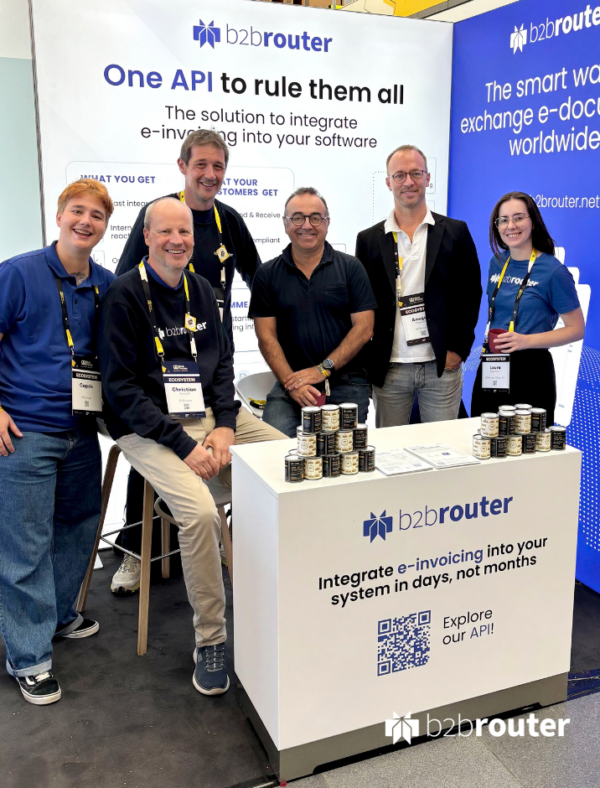
B2Brouter at Bits & Pretzels 2026: what we learned in Munich
Last updated: October 1, 2026
From 28 to 30 September, the B2Brouter team joined Bits & Pretzels 2026 in Munich, one of Europe’s leading events for startups, SaaS companies, investors and technology providers. With around 7,500 attendees, the event brought together companies from across the European tech ecosystem for talks, networking, matchmaking and new business opportunities.
For us, it was a chance to meet companies face to face, understand how they are approaching electronic invoicing and discuss what the next regulatory changes mean for their products and businesses.
One thing became particularly clear in Munich: companies know Germany’s e-invoicing regulation is coming, but many are still not operationally ready for it.
Awareness is high. Readiness is not.
One of the clearest takeaways from Munich was that awareness is no longer the main challenge.
Virtually everyone we spoke to knew about Germany’s transition towards mandatory B2B electronic invoicing. But when the conversation moved from “Do you know about the regulation?” to “Are your systems already prepared?”, the answer was very different.
Many companies are still evaluating what they need to do, which technology they will use or how e-invoicing should fit into their existing products and processes.
And the transition has already started.
Since January 2025, German businesses have needed to be able to receive electronic invoices. Mandatory issuance will then progressively apply from 2027, for businesses above the relevant turnover threshold, and more broadly from 2028.
If you are still preparing your processes, our guide to e-invoicing in Germany provides an overview of the formats, requirements and options available.
Knowing the deadline is not the same as being operationally ready for it. Waiting too long can turn a planned transformation into a last-minute project involving finance, IT, operations and customers at the same time.
More than XRechnung or ZUGFeRD
Another recurring topic at our booth was that preparing for Germany involves much more than choosing an invoice format.
Of course, XRechnung and ZUGFeRD are central to the German e-invoicing landscape, while Peppol BIS also plays an important role in international and cross-border exchange.
But the real questions go deeper:
- Is the right invoice data already available in your systems?
- Can it be validated before the invoice is sent?
- How will errors or rejections be handled?
- How will the process integrate with your ERP or SaaS platform?
- What happens when another country introduces different requirements?
That is why electronic invoicing should not be treated simply as a format-conversion project.
It is increasingly becoming an infrastructure and business-process decision.
From Regulation to Opportunity
This idea was also at the heart of our masterclass:
From Regulation to Opportunity: Riding the E-Invoicing Wave
During the session, Ansgar Mondorf, who leads B2Brouter’s business development in Germany, explored how companies can prepare for upcoming e-invoicing requirements without treating every new mandate as a separate IT project.
Germany is only one part of a much broader European transformation.
France, Poland, Belgium, Spain and other markets are adopting different e-invoicing and reporting models, while European initiatives such as VAT in the Digital Age (ViDA) are pushing towards greater digitalisation and harmonisation.
For companies operating internationally, the strategic question is therefore not only:
“How do we comply with Germany?”
It is also:
“How do we build something that can adapt to the next country?”
That distinction becomes especially important for SaaS and ERP providers, where every country-specific integration creates additional development, maintenance and compliance work.
The hardest part is often the data behind the invoice
One of the key points discussed during the masterclass was that generating an XML file is only one part of e-invoicing.
Structured invoicing depends on having the right information available from the beginning: tax identifiers, addresses, routing data, tax classifications and other business information all need to be accurate and structured correctly.
If the underlying data is wrong, generating the correct technical format will not solve the problem.
This is also why e-invoicing cannot remain exclusively an IT project.
It affects finance, procurement, sales, legal and technology teams, because invoice validation, approvals, corrections, status management and reporting increasingly become part of the same process.
For management teams, preparing early therefore means more than choosing a provider. It means understanding where invoicing data comes from, who owns the process and what needs to change before the obligation becomes critical.
A different way to connect
Bits & Pretzels also stood out for the way networking was built into the event.
Alongside the booth area, talks and informal meetings, formats such as speed dating and matchmaking sessions encouraged short, direct conversations between startups, software companies, investors and potential partners.
That dynamic made the event particularly useful for quickly discovering what companies are building, which markets they are entering and where topics such as e-invoicing, APIs or international expansion are starting to become relevant.
For an event centred on technology and growth, these fast exchanges complemented the deeper conversations happening throughout the conference.
One API for an increasingly complex landscape
Many conversations eventually came back to the same problem.
A software provider might start with Germany and support XRechnung or ZUGFeRD.
Then a customer asks for France. Another expands into Spain. Another needs Peppol.
What initially looked like one integration can quickly become an entire ecosystem of formats, networks, validations and regulatory requirements.
This is where interoperability becomes strategic.
Through networks such as Peppol, companies can exchange structured documents using common mechanisms for participant discovery, routing, validation and delivery instead of relying exclusively on individual point-to-point connections.
For SaaS companies and ERP providers, the question is therefore not only how to comply.
It is where that complexity should live.
One API to rule them all.
B2Brouter acts as an interoperability layer between software products and the increasingly complex international e-invoicing landscape, allowing companies to connect with different formats, networks and regulatory environments through a common infrastructure.
Companies that already work from an ERP can integrate e-invoicing directly into their existing system, while software providers can use the B2Brouter e-invoicing API to automate sending, receiving and status management.
For international Peppol connectivity, our Peppol API provides a single integration point to connect ERP, SaaS and business software with the network.
Our main takeaway from Munich
Bits & Pretzels confirmed something important:
The market is aware. Now it needs to move from awareness to execution.
German e-invoicing is already firmly on companies’ radar.
What many organisations still need is a concrete strategy for their data, technology and processes.
For CEOs and management teams, this is ultimately about more than meeting a deadline.
Preparing early can mean avoiding rushed technology decisions, reducing internal complexity and building an infrastructure that supports international growth rather than having to be redesigned every time another market changes its rules.
That was the common thread behind our booth conversations, our masterclass and the meetings we had throughout Bits & Pretzels:
Prepare for Germany, but build for what comes next.
A big thank you to everyone who stopped by our booth, attended the masterclass or simply took the time to share their challenges with our team.
See you at the next one. 🚀
Building e-invoicing into your software or ERP?
Connect your existing system with B2Brouter and manage formats, networks and international e-invoicing requirements through a single integration.
Explore e-invoicing integrationFor development teams, explore our e-invoicing API or our Peppol API.