

Legacy EDI is on borrowed time: Preparing for Germany’s 2027 outbound mandate
Last updated: September 25, 2026
The digital transformation of corporate finance within the European Union is no longer a prospective multi-year roadmap initiative; it is a rigid legal reality. And this legal reality is coming really soon for Germany.
While many enterprise IT and product teams focused their resources on meeting the January 1, 2025, inbound reception mandate, a much more formidable architectural hurdle is rapidly approaching. On January 1, 2027, Germany will shift from passive invoice reception to mandatory structured electronic invoice issuance for all domestic Business-to-Business (B2B) transactions where the supplier’s prior-year turnover exceeds €800,000. By January 1, 2028, this requirement will swallow the remainder of the B2B market, entirely eliminating paper invoices and standard, unstructured PDFs.
For organizations relying on legacy Electronic Data Interchange (EDI) systems, this countdown is a critical operational risk. Traditional point-to-point EDI connections running legacy syntaxes without semantic validation frameworks are fundamentally incompatible with the incoming German legal framework.
Without a strategic technical bridge, these legacy pipelines will fail mandatory compliance checks at the recipient’s gateway, halting payment cycles and exposing enterprises to significant regulatory friction. This article analyzes the precise architectural mechanics of the 2027 mandate, details why legacy EDI setups are on borrowed time, and explains how B2Brouter offers a non-disruptive pathway to total compliance without a costly, bottom-up IT overhaul.
The technical reality of Germany’s B2B mandate and EN 16931
To safeguard outbound compliance, product managers and IT architects must understand that the German mandate explicitly moves away from visual verification toward automated, programmatic verification. As highlighted in the official repository “e-invoicing Germany”, an authentic electronic invoice under the new law must provide content in a structured, machine-readable XML data set. This architecture ensures that invoice transmission, reception, and processing can occur seamlessly and automatically without manual intervention.
The foundational benchmark for compliance is the European standard EN 16931. This standard establishes a unified semantic data model across the European Union. In Germany, the final eInvoicing guidelines published by the Federal Ministry of Finance (BMF) explicitly define the permissible national syntaxes that conform to EN 16931.
The permitted German architectural syntaxes
| Format type | Structural composition | National governance / Use case |
| XRechnung | Pure XML data file utilizing Universal Business Language (UBL 2.1) or UN/CEFACT Cross Industry Invoice (CII) syntaxes. | Maintained by KoSIT (Coordination Office for IT Standards). The default Core Invoice User Specification (CIUS) for public sector transactions. |
| ZUGFeRD (2.1 / 2.3 / 3.1) | Hybrid format integrating a human-readable PDF/A-3 document with an embedded, compliant XML data record. | Governed by FeRD; designed to bridge the gap between human visual verification and automated ERP parsing. |
| Peppol BIS Billing 3.0 | International electronic invoicing standard operating over the secure Peppol eDelivery network. | Explicitly recognized in the final BMF guidelines as a permissible European invoice format. |
The digital VAT reporting distinction
A common point of confusion among IT teams is the relationship between structural eInvoicing and live tax enforcement. Under the current execution of the Growth Opportunities Act, Germany has not deployed a real-time digital VAT reporting or transaction monitoring system.
While the transaction must happen via structured XML, there is no concurrent real-time clearance hook directly into state servers. However, this is a deliberate interim architecture. The German federal administration designed this framework to align cleanly with the impending European Union VAT in the Digital Age (ViDA) initiative, which will introduce harmonized intra-community real-time digital reporting requirements. Enterprise architectures built today must be flexible enough to incorporate these reporting hooks when they become operational.
Why legacy EDI will fail validation checks in 2027
A dangerous misconception persists within enterprise IT departments: “We have been exchanging EDIFACT files with our major trading partners for twenty years; therefore, our outbound channels are inherently compliant.” This assumption is false.
Traditional EDI architectures were engineered for deep supply chain automation and inventory reconciliation between known parties. They were not designed to serve as a standardized, cross-industry tax compliance tool.
The vulnerability of legacy data structures
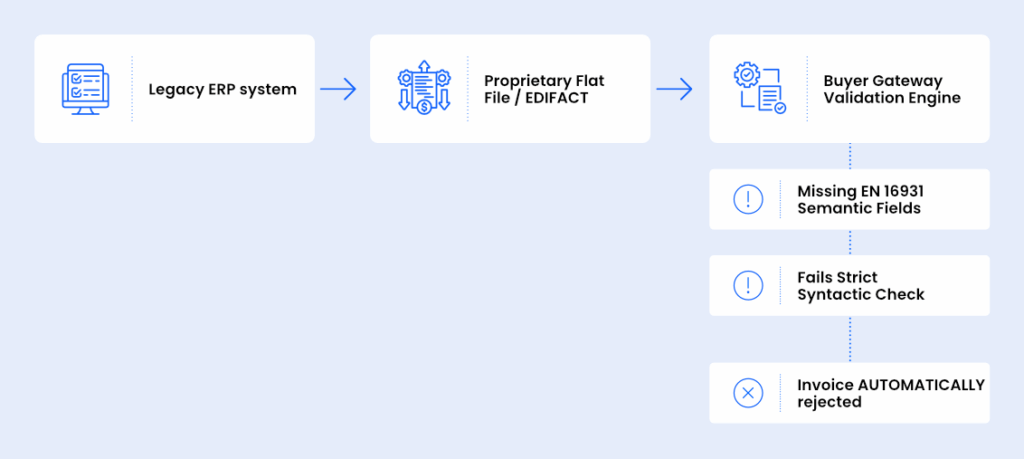
Legacy EDI formats (such as various subsets of UN/EDIFACT like INVOIC, or proprietary flat files and IDocs) rely on rigid, point-to-point data mapping. The data structures are frequently highly customized, filled with proprietary segments, and missing the strict semantic fields required by EN 16931.
An EN 16931-compliant invoice mandates the presence of specific, explicitly validated data elements. This includes structured tax break-downs, exact currency codes, and precise identifiers like the Buyer Reference (BT-10), which frequently incorporates the German routing path ID (Leitweg-ID) in public and enterprise routing systems. If your ERP emits a legacy EDI file that drops or misaligns these mandatory semantic fields, that file is non-compliant.
The illusion of bilateral consent
IT and procurement teams often point to a specific clause in the final BMF letter: the guidelines state that EDI procedures may still be used during the transitional periods of 2027 and 2028. However, looking closer at the regulatory text reveals a critical legal limitation.
Non-EN-compliant EDI invoices are only permissible if both contracting parties mutually agree to their use via a bilateral agreement. This means your enterprise is entirely dependent on the technical willingness of your clients.
If a major buyer exercises their legal right under the Growth Opportunities Act and demands an EN 16931-compliant format (such as an XRechnung XML file or a ZUGFeRD document), your legacy point-to-point EDI system cannot fulfill that request without custom modification. If you cannot supply the format the customer demands, your outbound processing engine breaks down entirely.
The validation bottleneck at the recipient’s gateway
In the modern German B2B ecosystem, reception platforms do not simply receive files and drop them into a queue for manual accounting. Recipients are rapidly deploying automated ingestion systems that execute rigid, programmatic syntactic and semantic validation checks at the perimeter firewall.
We can observe this operational model by examining the recent evolution of Germany’s public administration sector. As detailed in “e-invoicing Germany”, the federal procurement authorities successfully consolidated their two main intake nodes—the ZRE (Federal Central Invoice Receiving Platform) and the OZG-RE (Online Access Act-compliant Invoice Submission Portal)—into a single, unified digital portal in late 2025. This consolidated platform runs strict validation algorithms. Any inbound file that fails to align perfectly with the XRechnung schema or other approved standards is rejected automatically.
The private sector is rapidly adopting this exact defensive architecture. Enterprise buyers are configuring their automated accounting software to automatically reject non-compliant formats. If your outbound pipeline transmits a legacy EDI file without CEN-compliant data extraction, the buyer’s gateway will reject the transaction before it ever reaches a human accounts payable clerk. The invoice is treated as legally unissued, creating immediate collection delays and compliance exposure.
The nightmare of the “rip-and-replace” IT overhaul
When confronted with this architectural mismatch, the traditional response from IT executives is to plan a comprehensive system upgrade: a multi-million-euro project to update the core Enterprise Resource Planning (ERP) platform or write custom, native mapping scripts within the legacy billing engine to output compliant XML natively.
For the vast majority of organizations, this strategy is an operational and financial pitfall.
- Immense resource drain: Rewriting native transactional engines to emit compliant EN 16931 XML requires mapping data from the lowest database layers up to the presentation stack. It demands hundreds of developer hours spent deciphering complex schemas, building custom validation loops, and modifying fragile legacy code bases.
- The talent shortage trap: The German market is experiencing an unprecedented shortage of specialized IT consultants and SAP/ERP integration engineers. As thousands of domestic companies simultaneously realize they must hit the January 1, 2027, deadline, vendor backlogs are expanding. Waiting for a native ERP update risks missing the legal compliance deadline entirely.
- Operational disruption: Deep alterations to core billing software risk introducing regressions into adjacent financial systems, inventory ledgers, and logistics pipelines. The risk of unintended system downtime during a “rip-and-replace” project is highly disruptive to daily corporate operations.
Bridging the gap: How B2Brouter translates legacy data into compliance
Rather than forcing an expensive and disruptive modification of internal transactional systems, forward-thinking product managers and IT architects are deploying an intelligent compliance abstraction layer. B2Brouter solves this engineering challenge by decoupling internal legacy EDI data generation from external regulatory compliance formats.
Seamless ingestion of legacy outputs
With B2Brouter, IT teams do not need to modify their existing ERP workflows or decommission their working legacy EDI configurations. If your internal billing engine is configured to emit proprietary flat files, legacy EDIFACT messages, or standard internal XML structures, B2Brouter ingests those files exactly as they are currently generated. The internal software architecture remains completely undisturbed.
CEN-compliant data extraction and translation
Once the legacy file enters the B2Brouter platform, the translation engine parses the raw data fields, maps them to a centralized canonical semantic model, and extracts the core invoice parameters. B2Brouter automatically restructures this data to match the strict schema definitions mandated by EN 16931.
The system enriches the data, formats the syntax correctly, and converts the legacy payload into fully compliant compliance outputs:
- A pure data XRechnung document (complying with UBL 2.1 or CII specifications)
- A hybrid ZUGFeRD profile (complete with a legally sound PDF/A-3 container wrapped around the verified XML payload).
- A Peppol BIS Billing 3.0 document.
This architectural abstraction transforms your legacy, non-compliant output into a perfectly valid German tax asset before it ever reaches the recipient.
Automated pre-flight validation mechanics
To prevent gateway rejections and broken payment runs, B2Brouter contains an integrated, real-time validation engine. Before any outbound invoice is dispatched to a buyer, it undergoes an automated “pre-flight” check against the exact, current validation schemas used by the German tax authorities and enterprise ingestion nodes.
If an invoice is missing a mandatory field—such as a specific tax registration number or a valid Leitweg-ID—B2Brouter flags the error instantly, permitting programmatic or manual correction before submission. Your external trading partners never see a failed transaction, securing your cash flow.
Delivery and interoperability: Moving beyond email
The technical challenges of the 2027 mandate extend beyond data formatting; they also encompass secure data transmission. While the final BMF guidelines clarified that providing a standard email address is sufficient to meet the basic 2025 reception requirements, relying on unencrypted email for large-scale outbound compliance is an operational vulnerability. Email offers no native delivery tracking, lacks automatic ingestion confirmation, and creates security risks for sensitive corporate financial data.
B2Brouter provides comprehensive interoperability by supporting all primary transmission channels approved under the German federal framework:
The strategic power of Peppol
As documented in the official German eInvoicing analysis, the National IT Planning Council mandates that public authorities must support Peppoltransmission for automated data exchange. In parallel, the German B2B market is adopting Peppol as the preferred network for automated, high-volume document exchange.
Managing thousands of individual point-to-point connections with different corporate clients requires significant technical overhead. B2Brouter solves this by acting as an accredited Peppol access point, certified under the governance frameworks overseen by KoSIT (the German Peppol Authority).
By connecting your legacy ERP to B2Brouter, your system gains instant, secure routing access to the entire international Peppol network. An outbound invoice is automatically routed to the recipient’s unique Peppol ID without requiring your IT team to configure separate bilateral connections for every customer.
Conclusion and action plan for IT leaders
The regulatory timeline established by Germany’s Growth Opportunities Act leaves no room for corporate procrastination. The period of passive invoice reception is a transitional phase; the upcoming January 1, 2027 outbound mandate introduces mandatory, active enforcement of structured electronic invoice creation for enterprises exceeding the €800,000 threshold.
Relying on unadjusted legacy EDI configurations or hoping for uninterrupted bilateral consent is a significant operational risk that can lead to automated gateway rejections, disrupted cash flows, and compliance violations.
Product and IT teams do not have to accept the disruption, cost, and delays of a native “rip-and-replace” core ERP modification. By deploying B2Brouter as an agile compliance translation layer, your organization can preserve its existing internal IT infrastructure while instantly gaining the ability to output fully validated, EN 16931-compliant XRechnung, ZUGFeRD, and Peppol invoices.
Recommended immediate steps:
- Audit your outbound landscape: Identify all current billing channels emitting paper, unstructured PDFs, or non-CEN-compliant legacy EDI formats.
- Segment your customers: Determine which major accounts will require native EN 16931 compliance by 2027, eliminating dependence on fragile bilateral EDI agreements.
- Decouple and secure: Schedule a technical architecture assessment with the B2Brouter integration team to establish a non-disruptive, future-proof data translation pipeline well ahead of the 2027 deadline.